
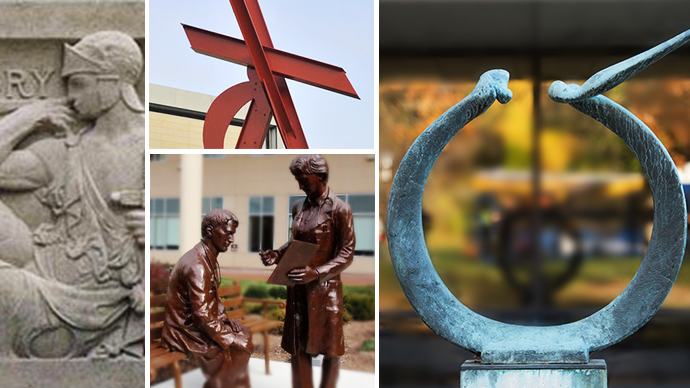
The University of Michigan aspires to possess a cohesive public art collection of national significance. Acting as a central review mechanism for works of art proposed for placement on the university campus, and acting in accordance with the committee charge, the President’s Advisory Committee on Public Art (PAConPA) strives to foster the enrichment of the university’s visual environment by positioning works of public art of the highest caliber in settings appropriate to the scale, purposes, aesthetics, and materials of individual works.
The Committee will:
- Provide strategic guidance to the president on matters concerning long- and short-term public art, and the University of Michigan public art collection. This includes:
- Evaluating university-wide public art proposals and providing recommendations for or against the proposals to the president; while
- Providing assurance that all recommended public art acquisitions and installations include adequate initial and long-term institutional funding, including, but not limited to, financial support for commission fees, transportation, site preparation, ongoing maintenance and restoration, and/or removal; and
- Conducting periodic review of the current public art collection, as well as available public art sites, as a means to informing future acquisitions.
- Advocate for public art and the university’s public art program and assist in the cultivation of resources for public art.
- Strive to foster the enrichment of the university’s visual environment by positioning works of public art of the highest caliber in settings appropriate to scale, purpose, aesthetics, and material of individual works.
- Apply a consistent set of criteria to proposed works of public art and acquisitions, as outlined in the committee’s guiding philosophy and approach.
- Evaluate all public art proposals in coordination with the appropriate university partners, including but not necessarily limited to: the Office of the University Planner, the Exterior Elements Design Review Committee, and the President’s Advisory Committee on University History.
Lend input and be available to advise on aesthetic matters that fall outside of the scope of its charge.
Christina Olsen
Director and Curator, University of Michigan Museum of Art
Ex-Officio Members
Mark Clague
Professor of Music and Associate Dean for Collaborations and Partnerships, School of Music, Theatre, and Dance, Interim Executive Director of the University of Michigan Arts Initiative
Susan Gott
Associate Director for Planning and Communications, Architecture, Engineering & Construction
Carlos Jackson
Dean and Professor of Art and Design, Penny W. Stamps School of Art and Design
Helmut Puff
Interim Chair, Department of History of Art, LSA, Professor of History and Germanic Languages and Literatures, LSA, Professor of History and Women’s and Gender Studies, LSA
Karen Thole
Robert J Vlasic Dean of Engineering, Professor Mechanical Engineering and Professor of Aerospace Engineering, College of Engineering
Steve Yaros
Chief of Staff, Office of the President
Members at Large
Tom Finholt
Vice provost for Academic and Budgetary Affairs, Office of the Provost and Executive Vice President for Academic Affairs, Professor of Information, School of Information
Anthony Kolenic
Director, Matthaei Botanical Gardens
Susan Pile
Senior Director, University Unions & Auxiliary Systems, Student Life
Michael Rein
Director of Community Relations, Office of Government Relations
Carrie Throm
Assistant Vice President, Leadership & Major Gifts, Office of University Development
Quinta Vreede
Chief Administrative Officer, Michigan Medicine
Student Members
Jasmine Barnes
Undergraduate Student, Art Design
Navjeet Kaur
Fine Arts, Master’s Candidate
Committee Staff
Jennifer Carty
Curator of Art in Public Spaces, University of Michigan Museum of Art
Diana Caulkins
Executive Assistant & Project Coordinator, Office of the President
Erika Larson
Manager of Art in Public Spaces, University of Michigan Museum of Art
Devon Redmond
Project Manager, Office of the President
*The director of the University of Michigan Museum of Art, the university planner, the Executive Director of the Arts Initiative, the Dean of Penny W. Stamps School of Art and Design, the Chair of the Department of History of Art, the Dean of Engineering, and the Office of the President’s Chief of Staff are all ex officio voting members of the committee. The Office of the University Planner will provide technical support for the committee. Other staffing for the committee will be supported by the Office of the President.
For purposes of the work of this committee, “public art” is defined as installations of art—permanent or temporary—in public spaces of the university, which include exteriors of buildings, outdoor public areas, or interior public lobbies. Although we cannot always clearly separate public art from architectural elements or other exterior elements, the following guidelines will help us define the scope of the committee’s activities. In situations of potential overlap, relevant committees and units will work cooperatively to resolve questions and develop recommendations. At this time, the President’s Advisory Committee on Public Art only evaluates public art on the Ann Arbor campus.
Public art includes:
- Art works located outside of buildings on the campus grounds or in public lobbies;
- Free-standing original pieces of sculpture, made of any material, including those commissioned as part of new building construction;
- Art works such as decorative tiles or mosaics which are embedded in locations such as sidewalks and seat walls;
- Outdoor utilitarian elements—such as memorial and sculptural benches, nonstandard light fixtures, or drinking fountains—that are unique works of art;
- Works of art attached to or incorporated into the exterior facades of buildings; and
- Free-standing artifacts that have been in the landscape for a long period of time.
Public art does not include:
- Functional exterior building features. It should be noted, however, that in some situations functional exterior elements might also constitute essentially distinct, if not free-standing, works of public art or may also serve as decorative elements. In such cases, the PAConPA should be consulted.
- Art displayed inside buildings, which thereby fall under the purview of the unit responsible for the building. Similarly, art works installed in courtyards that are enclosed within the footprint of a building also fall under the purview of the responsible unit or units. An exception to this policy is public lobby spaces, noted above. In such cases, the PAConPA should be consulted. Units are welcome and encouraged to seek advice from the advisory committee for significant installations of art in their interior public spaces.
- Landscaped features—except where undertaken as a form of land art or public art.
Public Art Categories:
The PAConPA organizes public art into three temporal categories: long-term (and permanent) installations, short-term installations, and events. The definitions for each category follow.
Long-term Installations
Long-term installations include both temporary and permanent installations of public art lasting 6 months or more. Long-term installations may arise under three circumstances:
- An existing work is proposed as a gift or long-term loan to a specific campus unit;
- A unit desires to purchase an existing work of public art with donor or institutional funds; or
- A unit desires to commission a work of public art with donor or institutional funds.
If you are interested in submitting a proposal for a long-term installation, please visit the Applications page to learn more.
Short-term Installations
Short-term installations are defined as installations of public art lasting from 6 days to 6 months. Such installations will primarily be works of art created by U-M faculty and students in association with academic programs. If you are interested in submitting a proposal for a short-term installation, please visit the Applications page to learn more.
Events
Events are defined as public art activities or set-ups that last 5 days or fewer. PAConPA will not typically play an authorizing role in events sponsored by academic units or Student Life. Proposals for events must be directed to the Special Events Coordinator in the Office of the Associate Vice President for Facilities and Operations. Proposals must be submitted at least 3 weeks before the planned date of the event. More information can be found through university Facilities and Operations.
Purpose and Approach
Public art has the ability to inspire, provoke and challenge. The broad purpose and mission of public art at the University of Michigan is to offer the campus community and the public transformative experiences with art; to raise challenging, timely issues and ideas; and to deepen our experience of place and community.
The University of Michigan aspires to possess a cohesive public art collection of national significance. Acting as a central review mechanism for works of art proposed for placement on the university campus, and acting in accordance with the committee charge, the President’s Advisory Committee on Public Art (PAConPA) strives to foster the enrichment of the university’s visual environment by positioning works of public art of the highest caliber in settings appropriate to the scale, purposes, aesthetics, and materials of individual works.
Criteria
In evaluation of all public art proposals, the PAConPA applies a consistent set of criteria to works of public art that are offered to the university, as well as works that the university or its units proactively acquire. These criteria include:
- The aesthetic significance of an individual work of public art;
- The significance of the art or artists;
- The relative uniqueness of the work of art, including factors of originality and authenticity;
- The ethical position occupied by the work of art, including consideration of provenance;
- The contribution to the university’s educational mission and existing public art collection; and
- The appropriateness of site, including surrounding architecture, hardscaping, landscaping, and public safety.
Public art sites are prioritized by prominence, visibility, history, and site lines. Criteria for proposed public art projects will be applied specifically in accordance with site prominence, with weighted consideration for the most prominent sites. Evaluation of public art proposals will be informed in consultation with the University Planner. Proposals are assessed by these criteria and the relationship to the entire collection and whether the proposed work brings diversity, range, and balance to the whole public art collection.
The President’s Advisory Committee on Public Art (PAConPA) welcomes proposals from university schools, colleges, departments, units, faculty, students, and staff.
Proposals from individuals or organizations from outside of the university should be made in collaboration with a university partner. All long-term and short-term proposed works of public art for the Ann Arbor campus must be reviewed by the PAConPA under principles and procedures developed by the committee. The committee reviews all proposed works of public art and recommends (for or against) to the president of the University of Michigan for a final decision.
Because many works of public art offer both logistical and technical challenges, the University Planner’s Office (UPO), is closely involved. Approval by UPO is required with respect to safety, security, accessibility, and impact on property. The UPO will coordinate with the Special Events Coordinator and the Exterior Elements Design Review Committee (EEDR) within U-M AEC to verify no conflicts exist with planned events for a given location.
The process length will vary but will oftentimes last 6 months or longer. Works of art are unique in nature. Therefore, further consultation with members of the PAConPA through the process outlined below is necessary to better determine the scope and approximate timeline of installation.
Individual units should contact PAConPA through the process outlined below as early as possible when considering acceptance of a gift or undertaking a purchase, loan, or commission of a new work of public art, or when considering siting or re-siting an existing work, especially in the case of a proposed gift of public art or gift funds to be used for the purchase or commission of a work of public art. Units may not offer guarantees of acceptance to prospective donors before the PAConPA and the president have approved a public art proposal. For more information regarding purchasing or commissioning artwork with donor or institutional funds, please see the public art guide for gifts, which offers additional information regarding acceptance of public art as gifts.
1. Initial Application of Interest
Any individual or unit with interest in submitting a proposal for the acquisition and installation of a work of public art should first notify the committee of their interest by emailing Public.Art.Committee@umich.edu. The email should include:
- First and Last Name of Principal Applicant and their Title/Position
- Participating Department(s)/Unit(s)
- Email Address
- Name of Artist
- Title and Dimensions of Piece
- A Brief Description of the Proposal
- A Brief Description of Funding
- Length of Exhibition (long or short term)
Please include photos when possible. If the project falls within the purview of the PAConPA, a representative of the committee will contact the principal applicant to schedule a meeting to discuss the potential project.
2. Public Art Proposal Form
After the initial meeting to discuss the potential project, the formal Public Art Proposal Form must be completed by the principal applicant (or department/unit) and submitted according to the instructions on the form.
If you wish to submit a proposal for a temporary work, please send an inquiry to Public.Art.Committee@umich.edu.
3. Committee Review of Proposed Public Art
Once all formal proposal details have been received, the PAConPA will meet to review and discuss the proposal and then provide a recommendation (for or against) to the president. The committee will weigh proposals against established criteria for public art. Typically, one of three outcomes is achieved:
- The committee recommends acceptance of the work, and the chair makes that recommendation in writing to the president.
- The committee recommends that the work not be accepted, and the chair makes that recommendation in writing to the president.
- The committee determines that the proposed work is not yet ready for recommendation (for or against) and requests further information from the requesting unit. In this event, it is the responsibility of the requesting unit to resolve any issues.
4. Presidential Review of Committee Recommendation
Once the president has communicated their decision on the recommendation back to the PAConPA chair, the chair will convey that determination to the requesting unit, the UPO, and the PAConPA. If approved, the installation process of the public art can begin in coordination with the UPO.
5. Installation Process in Coordination with the University Planner’s Office (UPO)
Logistical matters relating to proposals accepted by the president will be coordinated by the requesting unit with guidance from the UPO.
To inquire about submitting a proposal for a public art installation, to ask a question, or to request more information, please email Public.Art.Committee@umich.edu.
